
Preparedness in Action: How UT Police Maintain Firearms Proficiency
January 06, 2026
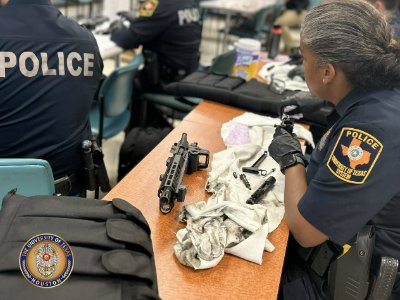
At UT Police, preparedness is more than a mindset; it’s a commitment. Every day, officers face a variety of challenges that require sharp skills, quick thinking, and confidence in their abilities. To maintain that readiness, UT Police engage in continuous training that hones both foundational and advanced law enforcement skills.
One key way officers stay prepared is through rigorous firearms qualification, ensuring each officer can safely and effectively handle their issued weapons while meeting and exceeding state-mandated standards.
A Readiness Skill That Exceeds Standards
Firearms qualifications remain a cornerstone of officer readiness, ensuring officers enter each year trained, accountable and prepared to meet the demands of their role.
UT System police officers are required to qualify with every firearm they are authorized to carry twice each year, exceeding the Texas Commission on Law Enforcement’s minimum annual requirement.
The Qualification Process
The division’s Firearms Proficiency Officer, Sergeant Jason Kingston, oversees the qualification process to ensure compliance, consistency and officer preparedness.
“At the beginning of each qualification period, like the one which we started this month, I review sworn personnel rosters and firearm assignment records and begin working with our certified firearms instructors who are responsible for verifying equipment, inspecting weapons and ensuring the accuracy of divisional records,” Kingston said.
The firearms instructors are a group of officers assigned across patrol shifts, investigative units and special operations who schedule and conduct the qualifications for their assigned personnel.
On Site Qualifications
Qualifications are typically conducted at the division’s on-site Weapons System Training Facility, Kingston said.
Each session begins with a mandatory range safety briefing that reinforces the rules of firearms safety, emergency response procedures and required protective equipment.
Officers also complete standardized UT System courses which evaluate foundational firearms skills, including loading, drawing, reloading and firing from multiple distances and positions under defined time constraints. “Firearms qualifications are not designed to replicate real-world encounters,” Kingston said, adding that other training addresses those concerns. “What firearms qualifications do is establish a baseline measure of proficiency in skills critical to officer safety and performance.”
Instructors also use qualification sessions to observe performance, identify potential deficiencies, and recommend additional training when needed.
Officers must meet minimum scoring standards to pass, with higher accuracy thresholds required for rifles and shotguns.
A Cycle Continues
Firearms qualifications are distinct from firearms training, but both play essential roles in officer development.
“Shooting and weapons handling are perishable skills that require regular practice, repetition and mental engagement to maintain competence,” Kingston said." Proper weapons handling and focus during qualifications reinforce habits officers rely on in the field, where dynamic conditions demand constant awareness and sound decision-making.”
Results of the qualifications are reported to the UT System in Austin for verification. Once approved, the qualification cycle concludes, and preparations begin for the next period.
“Through regular, standardized firearms qualifications and continued access to training resources, the division strengthens officer readiness and reinforces its commitment to professionalism, accountability and proactive public safety,” Kingston said.